
Blog
How to Do a Perfect Push-Up: A Step-by-Step Guide

Introduction to Push-Ups: A Compound Exercise for Overall Fitness
Push-ups are a fundamental exercise that offers a wide range of benefits, from building strength and endurance to improving flexibility and mobility. As a compound exercise, push-ups work multiple muscle groups simultaneously, making them an effective way to enhance overall fitness. When performed correctly, push-ups engage the pectoral muscles, triceps, and shoulder muscles, while also requiring the engagement of various other muscle groups for balance, core strength, cardio endurance, and stability. Given their versatility and effectiveness, push-ups are a staple in physical education and military training. To understand the full potential of push-ups, let’s delve into the proper form, common mistakes to avoid, and the muscles worked during this exercise.
Perfect Push-Up Form for Beginners
To reap the benefits of push-ups, it’s essential to master the perfect form. Here’s a step-by-step guide for beginners:
Starting Position:
- Begin in a plank position with your hands placed slightly wider than shoulder-width apart.
- Keep your wrists aligned with your shoulders and your fingers pointing forward or slightly outward.
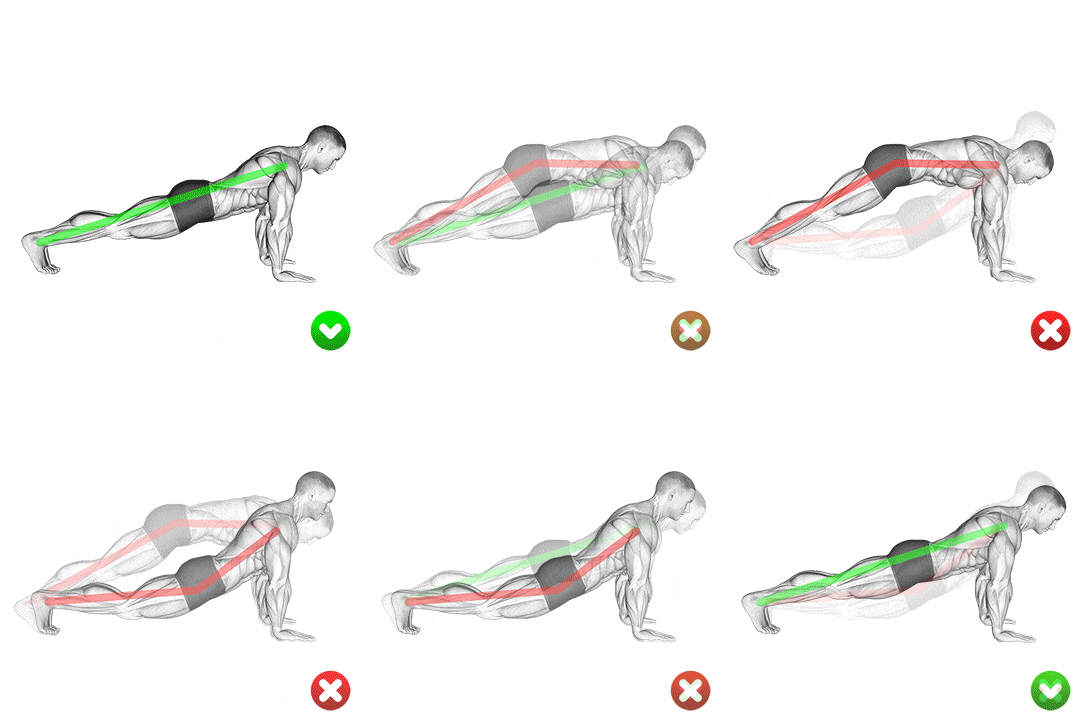
- Engage your core and maintain a straight line from your head to your heels. Avoid sagging your hips or arching your back.
Execution:
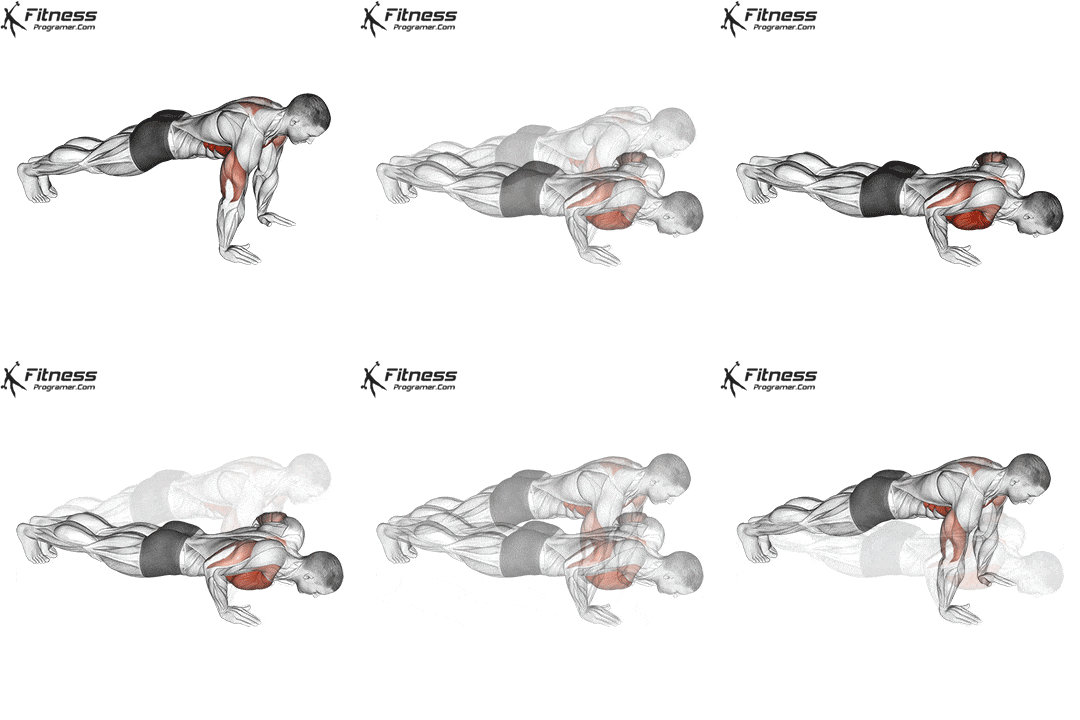
- Lower your body by bending your elbows while keeping them close to your torso.
- Lower yourself until your chest is about an inch above the ground or as far as your strength allows.
- Ensure that your body moves as a single unit; don’t let your hips sag.
- Push through your palms to extend your elbows and return to the starting position.
- Fully extend your arms without locking your elbows.
Breathing:
- Inhale as you lower your body.
- Exhale as you push yourself back up.
Common Mistakes to Avoid
While push-ups are beneficial, there are common mistakes that can reduce their effectiveness or lead to injury. Be aware of the following:
- Sagging Hips: Keep your body in a straight line from head to heels. Don’t let your hips dip or rise too high.
- Elbows Flaring Out: Keep your elbows close to your body to protect your shoulders.
- Incomplete Range of Motion: Lower your body until your chest is close to the ground. Going only halfway won’t give you the full benefits.
- Improper Hand Placement: Hands should be aligned with your shoulders, not too wide or too narrow.
Push-up Muscles Worked
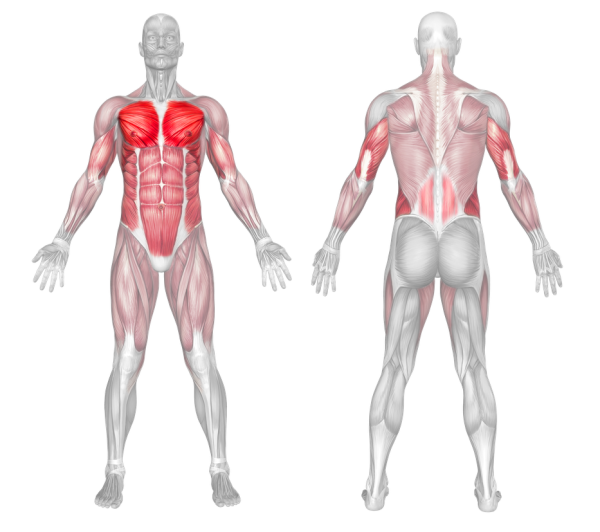
- Target – Pectoralis Major, Sternal
- Synergists – Pectoralis Major, Clavicular
- Synergists – Anterior Deltoid
- Synergists – Triceps Brachii
- Synergists – Trapezius
- Dynamic Stabilizers – Biceps Brachii
- Stabilizers – Rectus Abdominis
- Stabilizers – Pectoralis Minor
- Stabilizers – Serratus Anterior
- Stabilizers – Obliques
- Stabilizers – Quadriceps
- Antagonist Stabilizers – Erector Spinae
- Antagonist Stabilizers – Latissimus Dorsi
5 Important Benefits of Push-Ups
Push-ups offer a multitude of benefits that make them a valuable addition to any fitness routine. Here are five key advantages:
1. Full-Body Engagement
While push-ups primarily work the upper body, they also engage various muscle groups throughout the body. For example, the back muscles are involved in maintaining a stable posture, and leg muscles contribute to overall stability. This comprehensive engagement makes push-ups an effective full-body exercise.
2. Muscle Engagement
When performed correctly, push-ups primarily target the pectoral muscles (chest), triceps (back of the arms), and the deltoid muscles (shoulders). This engagement helps build both upper body strength and muscle definition. Beyond the primary muscle groups, push-ups engage various other muscles to maintain balance and stability. This includes the core muscles, which help stabilize the spine and pelvis, as well as the back, which assists in maintaining proper posture.
3. Cardio Endurance
Performing push-ups at a faster pace or in high repetitions can quickly elevate your heart rate. This increased heart rate is a key component of cardiovascular training, as it helps improve the efficiency of your cardiovascular system, including your heart and lungs. Push-ups can be performed in high repetitions or as part of a circuit training routine, making them an effective way to improve cardiovascular endurance when done at a faster pace.
4. Functional Exercise
Push-ups simulate pushing movements commonly encountered in everyday life, making them a functional exercise. This means that the strength and skills gained from push-ups can be directly applied to real-life situations, which is valuable in physical education and military training.
5. Muscle Endurance
Muscle endurance is the ability of a muscle or group of muscles to sustain a contraction over an extended period of time or to perform repeated contractions without fatigue. Push-ups require you to support your body weight for an extended duration during each repetition. This sustained effort places a significant demand on your muscles, contributing to improved endurance over time.
Create a Comprehensive Push-Up Routine
As a beginner, it’s crucial to prioritize proper form and technique over the number of repetitions. Gradually progress in terms of both repetitions and difficulty levels as you become more comfortable with each variation. Additionally, listen to your body and adjust the workout intensity if needed to prevent overexertion or strain.
Here’s an example of a beginner’s routine:
Warm-Up:
- 5-10 minutes of light cardio (e.g., jogging in place or jumping jacks)
- Dynamic stretches for the upper body, including arm circles and shoulder rolls
Push-up Workout Routine
Set 1: Standard Push-Ups
- 2 sets of 12-15 repetitions
- Rest for 30-60 seconds between sets
- Focus on maintaining proper form throughout each set
- If you can’t complete the desired number of repetitions with good form, perform as many as you can and gradually work your way up to the target range
Set 2: Incline Push-Up
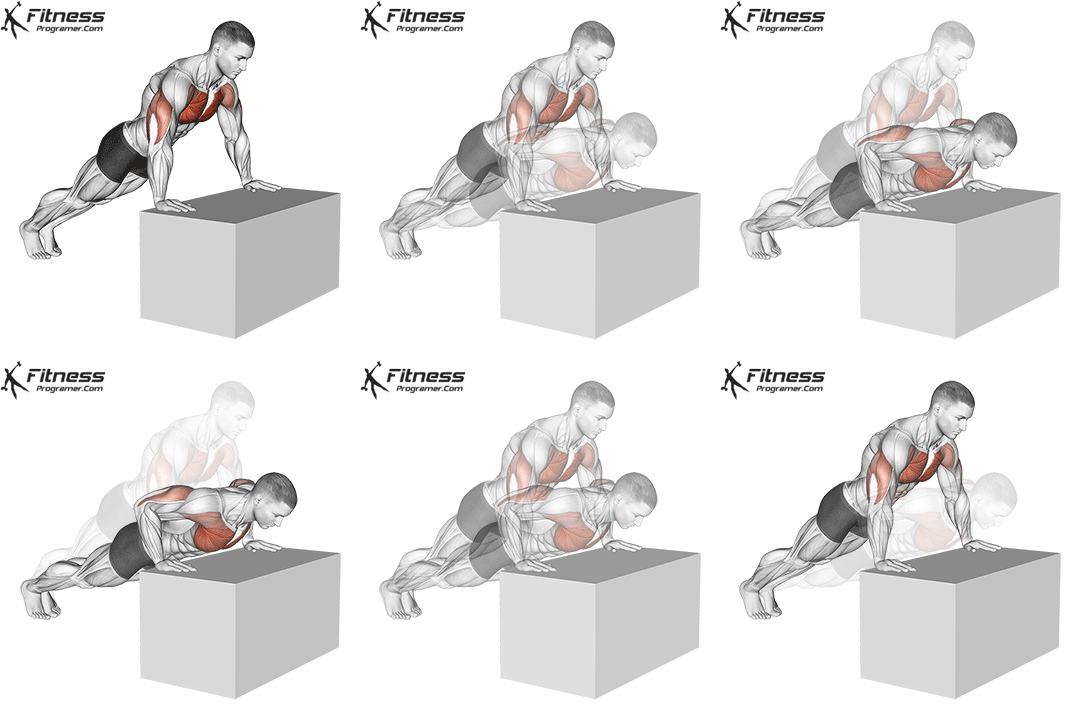
- 2 sets of 12-15 repetitions
- Rest for 30-60
Image Credit: fitnessprogramer.com